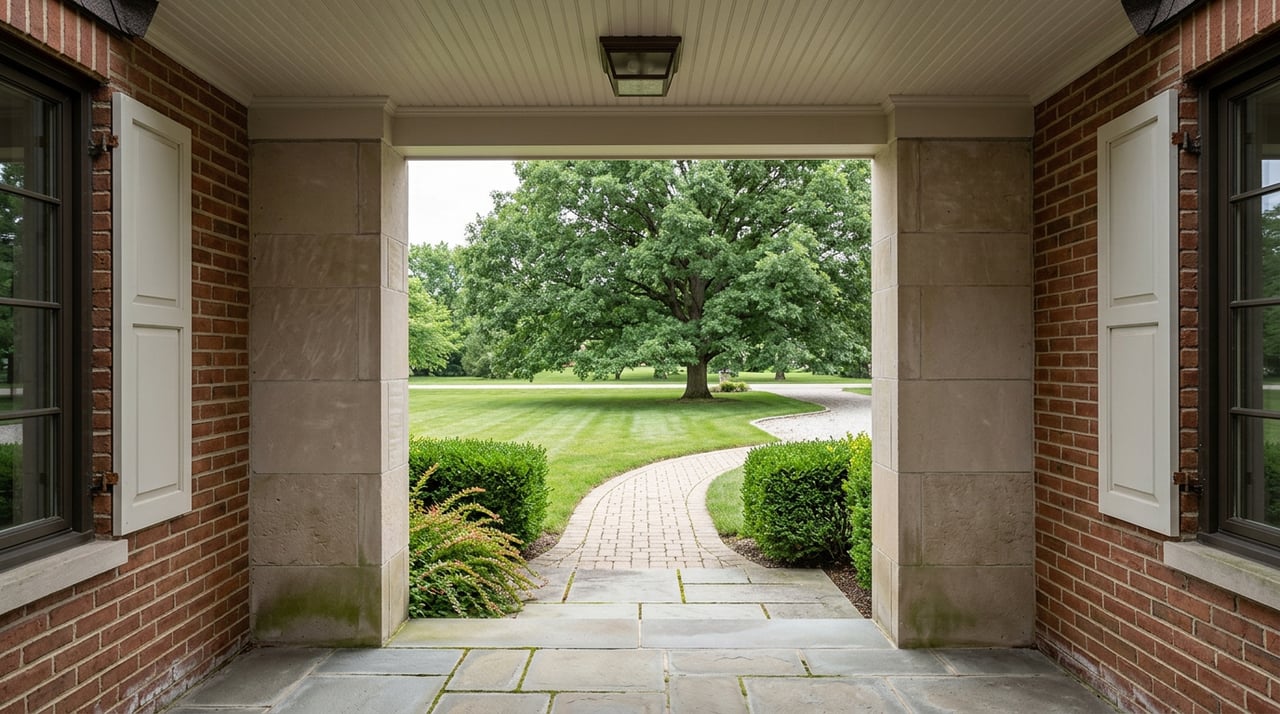
Freeburg IL Housing Market: What the Plant Closure Means in 2026
September 24, 2026
September 24, 2026
Sellers in Freeburg have been asking the same version of one question since last fall. If the town's oldest employer is shutting down and taking 110 jobs with it, should I be pricing my house lower to compete? It's a fair thing to wonder. It's also, based on what the actual sales data shows through the summer of 2026, the wrong question to be asking.
The plant in question is the Hubbell-Wiegmann facility on West Apple Street, a business that traces back to 1928 when Edgar Maurice Wiegmann started making metal outlet boxes in Freeburg. The company survived the Great Depression, expanded during World War II to produce ammo boxes and Post Office mail boxes, rebuilt after a tornado in 1968, and grew into a 225,000-square-foot operation before Hubbell Inc. acquired it from the Wiegmann family in 1994. For close to a century, it was the kind of employer a small town builds an identity around.
That identity is changing. A WARN notice filed with the Illinois Department of Commerce and Economic Opportunity confirmed layoffs for all 110 employees began in September 2025, with the work splitting between Hubbell's Aurora, Illinois facility and a plant in Juarez, Mexico. Freeburg Mayor Seth Speiser told KSDK the company had recently installed six expensive robots at the plant, which made the closure feel like a reversal nobody quite saw coming. "We thought maybe they weren't leaving," he said.
For the workers affected, this is a real loss. Richard Harris, a regional organizer with the sheet metal workers' union SMART, called the closure a betrayal of working families in comments reported by the Labor Tribune. A century of manufacturing history closing its doors deserves to be treated as more than a market footnote. That's the human side of this story, and it's worth sitting with before moving to the real estate side.
Here's the assumption most people carry into a situation like this. A town loses its anchor employer, workers either leave for new jobs or take pay cuts locally, demand for housing softens, and prices follow. It's a reasonable model. It's also not what happened in Freeburg, at least not yet, and the reason has less to do with the plant and more to do with what kind of town Freeburg actually is.
Freeburg sits a short drive from Interstate 64, close enough to Belleville, O'Fallon, Scott Air Force Base, and downtown St. Louis that a meaningful share of its residents were never employed at the plant to begin with. This is a commuter village, not a one-employer factory town. Losing 110 jobs matters enormously to the people who held them, but it doesn't remove the reason most Freeburg buyers showed up in the first place, which is proximity to jobs somewhere else entirely.
The village's own finances back this up. In a special board meeting on March 30, 2026, Freeburg's board unanimously adopted its 2026-2027 operating budget and approved raises rather than cuts, including a 10 percent pay increase for Village Administrator Matt Trout, Police Chief Mike Schutzenhofer, and ESDA Coordinator Gene Kramer, along with a 2 percent increase for Public Works Director Chris Remick. A village bracing for a housing downturn and shrinking tax base doesn't usually vote itself raises six months later.
If you go looking for Freeburg's current home prices, you'll find figures that don't agree with each other, and understanding why is more useful than picking a favorite.
As of July 2026, one major listing site put Freeburg's median list price at $292,000, down about 1 percent from July 2025. A second site's trailing 12-month figure showed a median sale price of $272,500, down roughly 3 percent from the prior year, across 63 total home sales over that stretch. Neither number looks like a town in freefall.
A more alarming figure has circulated since 2025: a reported 27 percent year-over-year price drop, built on just nine home sales in June of that year. It's the kind of number that sticks, but a sample of nine sales is thin enough that one $462,500 closing and one $145,000 closing landing in the same 30 days can swing a reported median by tens of thousands of dollars without reflecting any real shift in what the town is worth. It's also, at this point, a year old. The two figures actually covering 2026 tell a calmer story, and that gap between an eye-catching single month and a fuller annual window is worth remembering the next time a scary number about a small town shows up in a search result.
Price is useful, but pace is more telling. The same July 2026 source reported that homes in Freeburg were spending a median of 117 days on the market, and it noted that figure was unchanged from July 2025. That's the window covering the WARN notice, the start of the layoffs, and everything since. If a major local employer closing were pulling buyers out of the market, time on market is exactly where that hesitation would show up first. It hasn't moved. A second site put average time on market at 71 days, still above the national average of 58 days, but that gap looks like Freeburg's normal rhythm as a smaller village market rather than a new symptom of the plant closing.
Mayor Speiser offered one more detail worth paying attention to, separate from the housing numbers entirely. Speaking to KSDK, he said he doesn't expect the Hubbell-Wiegmann building to sit empty for long. "It's pretty big," he said. "I don't think they'll have a problem selling the building or finding somebody to move in there. Hopefully they do. Hopefully it's sooner rather than later."
A 225,000-square-foot facility with nearly a century of industrial infrastructure attached to it is not a small thing to backfill, but it's also not the kind of property that tends to sit vacant indefinitely in a region this close to the St. Louis metro's logistics and manufacturing corridor. Whatever moves into that building, if and when it does, will likely have more to say about Freeburg's next chapter than the closure itself did. That's a story worth watching separately from home values, and one we'll keep an eye on as it develops.
If you're selling in Freeburg this year, the plant closure is not a reason to price defensively. The number that would show buyer hesitation first, days on market, hasn't budged year over year. Price against comparable recent sales and how long those specific homes took to sell, not against a single month's blended median that might be carrying the weight of one unusual transaction.
If you're buying, don't expect the closure to have opened up a wave of price flexibility that the data isn't showing. Homes are taking roughly the same amount of time to sell as they did before any of this made the news, which means well-priced listings are still moving on their own timeline, not a discounted one.
And if you're watching Freeburg from outside, whether you grew up here, work at Scott Air Force Base, or are simply comparing it against other Metro East towns, the plant closure is a real event with real consequences for the families who worked there. It's just not, so far, a housing market event. Those are two different stories, and mixing them up is the easiest way to misprice a home in either direction.
For a closer look at what's currently listed in Freeburg, or to talk through how these numbers apply to your specific street or subdivision, visit our Freeburg neighborhood page. If you're weighing whether now is the right time to list, our seller resources walk through pricing strategy in more detail, and a free property valuation will give you a number grounded in actual recent sales rather than a single noisy month.
Freeburg's story right now isn't about a factory closing. It's about a small commuter town proving its housing demand was never as tied to that one address as the headlines assumed. If you want a local read on what that means for your specific situation, The Kehrer Team is here to help you sort the signal from the noise.
Stay up to date on the latest real estate trends.
We pride ourselves in providing personalized solutions that bring our clients closer to their dream properties and enhance their long-term wealth.